
When a passion for repairing cars becomes a business. What auto repair shop equipment should you choose to keep work running smoothly?

Interest in car repair often starts with maintaining your own vehicle, helping friends, or carrying out small jobs in a garage. As the number of customers grows and repairs become more complex, a basic set of tools is no longer enough.
To work safely, accurately, and without unnecessary delays, you need suitable auto repair shop equipment. That does not mean every possible machine must be purchased immediately.
The right equipment depends on the services you plan to offer, the types of vehicles you will work on, the technical limits of the premises, the available budget, the number of employees, and the expected workload.
In brief: a new general auto repair shop usually needs a suitable vehicle lift, an air compressor, quality tools, diagnostic equipment, a workbench, and equipment for collecting technical fluids. Tire service machines, air-conditioning service stations, wheel alignment systems, and other specialized equipment are better added once there is steady demand for those services.
Where should you start when planning an auto repair shop?
Before choosing equipment, define which services the shop will offer at the beginning.
These may include:
- routine maintenance and oil changes;
- brake and suspension repairs;
- exhaust system repairs;
- vehicle diagnostics;
- tire fitting and wheel balancing;
- air-conditioning system service;
- automotive electrical repairs;
- body repairs;
- coding and programming.
A shop focused on brakes and suspension will have different equipment needs from a tire shop or an automotive electrician. Start with equipment that will be used regularly and directly affects safety, work quality, and turnaround time.
A specialized machine used only a few times a year can tie up a large part of the budget. At the same time, cutting costs too heavily on everyday tools, a lift, or a compressor can slow down almost every job.
Check the premises before buying equipment
Your equipment choices are limited not only by the budget. The technical conditions of the premises are just as important.
Before ordering large equipment, check:
- ceiling height;
- the construction and condition of the floor;
- the width and length of the work area;
- vehicle access;
- 230 V or 400 V electrical connections;
- available electrical capacity;
- space for the compressor;
- the layout of compressed-air piping;
- ventilation and exhaust gas extraction;
- work-area lighting;
- storage space for tools and spare parts;
- safe routes for employees and vehicles.
Work equipment must be installed and used according to the instructions for the specific machine and the applicable Latvian occupational safety requirements for work equipment.
Do not rely on universal online advice about lift anchoring, floor thickness, or electrical connections. Requirements vary between models.
Set a realistic startup budget
The budget should include more than the purchase price of the equipment.
Allow for:
- delivery;
- installation;
- electrical and compressed-air connections;
- technical inspections;
- software licenses;
- maintenance;
- employee training;
- spare parts;
- personal protective equipment.
The cheapest offer is not always the most economical option in the long term.
What equipment is needed for different services?
| Planned services | Needed from the start | Can be added later |
|---|---|---|
| Brakes and suspension | Lift, hand tools, impact wrench, torque wrench, and compressor | Hydraulic press and specialized tools |
| Oil and fluid changes | Lift, oil drain tank, and filling equipment | Automatic transmission service machine |
| Vehicle diagnostics | Diagnostic tool, multimeter, battery tester, and battery support unit | Oscilloscope and programming equipment |
| Tire service | Tire changer, wheel balancer, compressor, and lift or jack | Helper arm, wheel washer, and wheel alignment system |
| Air-conditioning service | Air-conditioning service station and leak detection tools | System flushing and additional diagnostic equipment |
| General auto repair shop | Lift, compressor, tools, diagnostics, workbench, and fluid collection equipment | Tire, air-conditioning, ADAS, and other specialized equipment |
Essential auto repair shop equipment
Vehicle lift
A vehicle lift is one of the most important pieces of equipment in an auto repair shop. It is used for brake, suspension, exhaust, oil change, and many other jobs.
Small or newly opened shops often use:
- two-post lifts;
- full-rise scissor lifts;
- low-profile scissor lifts;
- single-post or mobile lifts when space is limited.
What should you check before buying?
- maximum lifting capacity;
- lifting height;
- minimum lifting-point height;
- arm or platform design;
- safety locking system;
- suitability for passenger cars and commercial vehicles;
- required ceiling height;
- floor and anchoring requirements;
- electrical connection;
- installation and servicing options.
Common mistake
The lift is chosen only by price or lifting capacity. A machine that is too large may not fit the premises, while an overly limited model may prevent the shop from servicing some customer vehicles. Consider the complete design and whether it suits the planned work.
Air compressor
An air compressor supplies compressed air to pneumatic tools, tire inflation equipment, cleaning guns, and tire changers.
What should you check before buying?
- actual delivered airflow;
- required working pressure;
- receiver tank capacity;
- duty cycle;
- electrical connection;
- noise level;
- condensate drainage;
- compressed-air quality requirements;
- availability of maintenance and spare parts.
The required compressor output should be based on the air consumption of the pneumatic tools and machines being used. Also consider simultaneous use, occasional demand peaks, possible leaks, and future expansion of the shop.
More technical information is available in the CAGI compressed-air system sizing guide.
Common mistake
The compressor is selected only by tank size. A large receiver does not compensate for insufficient airflow. An undersized compressor will run almost continuously, fail to maintain the required pressure, and wear out faster.
Vehicle diagnostic equipment
Modern vehicles rely heavily on electronic control systems. For this reason, vehicle diagnostic equipment is often used at the beginning of the repair process.
Depending on the tool and vehicle model, diagnostic equipment can be used to:
- read and clear fault codes;
- view live data;
- perform active tests;
- reset service intervals;
- perform brake, battery, and DPF service functions;
- adapt and code selected components;
- calibrate systems.
What should you check before buying?
- supported vehicle makes and models;
- scope of diagnostic and service functions;
- availability of active tests;
- coding and programming capabilities;
- software update terms;
- license costs;
- availability of technical support;
- warranty and repair terms.
A new shop does not necessarily need the most expensive diagnostic tool. It is more important to choose a model that matches the planned services and the vehicles you expect to work on.
Common mistake
The diagnostic tool is chosen by the number of advertised functions without checking coverage for specific vehicles or the ongoing cost of licenses.
During coding, programming, or lengthy diagnostic procedures, use a suitable battery support unit to maintain stable system voltage.
Hand, electric, and pneumatic tools
Quality automotive repair tools are the foundation of daily work. They are often used more frequently than large and expensive workshop machines.
A basic starter set usually includes:
- combination wrench sets;
- sockets and ratchets;
- screwdrivers;
- pliers and gripping tools;
- torque wrenches;
- an impact wrench;
- a drill and cordless screwdriver;
- hammers and pry bars;
- a multimeter;
- work lights;
- a tool trolley or cabinets.
What should you check before buying?
- whether the set includes the sizes used in daily work;
- tool material and durability;
- warranty terms;
- whether the set can be expanded later;
- drawer load capacity;
- tool layout and accessibility.
Common mistake
The set with the highest number of pieces is chosen. Some sets contain many rarely used items but lack the sockets and wrenches needed every day. It is more practical to start with a quality core set and expand it according to the work being carried out.
A torque wrench is especially important for jobs where components must be tightened to the vehicle manufacturer's specified torque.
Workbench and tool storage
Workbenches and workshop furniture, tool cabinets, and tool trolleys directly affect work organization. A mechanic should not need to cross the entire workshop several times to find one socket or screwdriver.
What should you check before buying?
- worktop durability;
- workbench dimensions;
- drawer and cabinet load capacity;
- availability of lockable compartments;
- tool-panel options;
- space for a bench vise;
- whether the bench can be combined with other workshop furniture.
Common mistake
The workbench and storage system are treated as minor purchases. A poorly organized work area causes unnecessary movement, slows down jobs, and increases the risk of tools being damaged or lost.
Tire changing and wheel balancing equipment
Tire service is in demand but highly seasonal. Before purchasing tire service equipment, assess the expected number of customers, the available space, and the ability to handle intensive seasonal work.
A basic tire service bay requires:
- a tire changer;
- a wheel balancer;
- a suitable air compressor;
- a lift or jack;
- an impact wrench;
- a torque wrench;
- tire inflation equipment;
- space for storing wheels.
What should you check before buying?
- supported wheel size range;
- suitability for low-profile and reinforced tires;
- suitability for SUVs and light commercial vehicles;
- availability of a helper arm;
- compressed-air requirements;
- availability of rim protectors and accessories;
- balancing accuracy and calibration procedure.
Common mistake
The tire changer is purchased without checking the compressor output or the range of wheels the shop plans to service.
If a complete workstation is required, ready-made tire changing and wheel balancing equipment packages are also available.
Oil change and technical fluid equipment
Oil and technical fluid collection equipment helps keep work cleaner, faster, and safer.
Depending on the services offered, you may need:
- waste oil drain tanks;
- oil extraction units;
- oil and transmission fluid filling equipment;
- brake bleeding equipment;
- drum pumps;
- spill trays;
- storage solutions for technical fluids.
What should you check before buying?
- tank capacity;
- adjustability of the collection funnel;
- mobility and wheel quality;
- emptying method;
- quality of hoses and connections;
- suitability for the fluids you plan to handle.
Common mistake
Fluid collection equipment is chosen only by capacity without considering ease of use or the emptying method.
Practical example: a one-bay general auto repair shop
This example is intended for a small shop with one mechanic that initially provides routine maintenance, oil changes, brake and suspension repairs, exhaust work, and basic vehicle diagnostics.
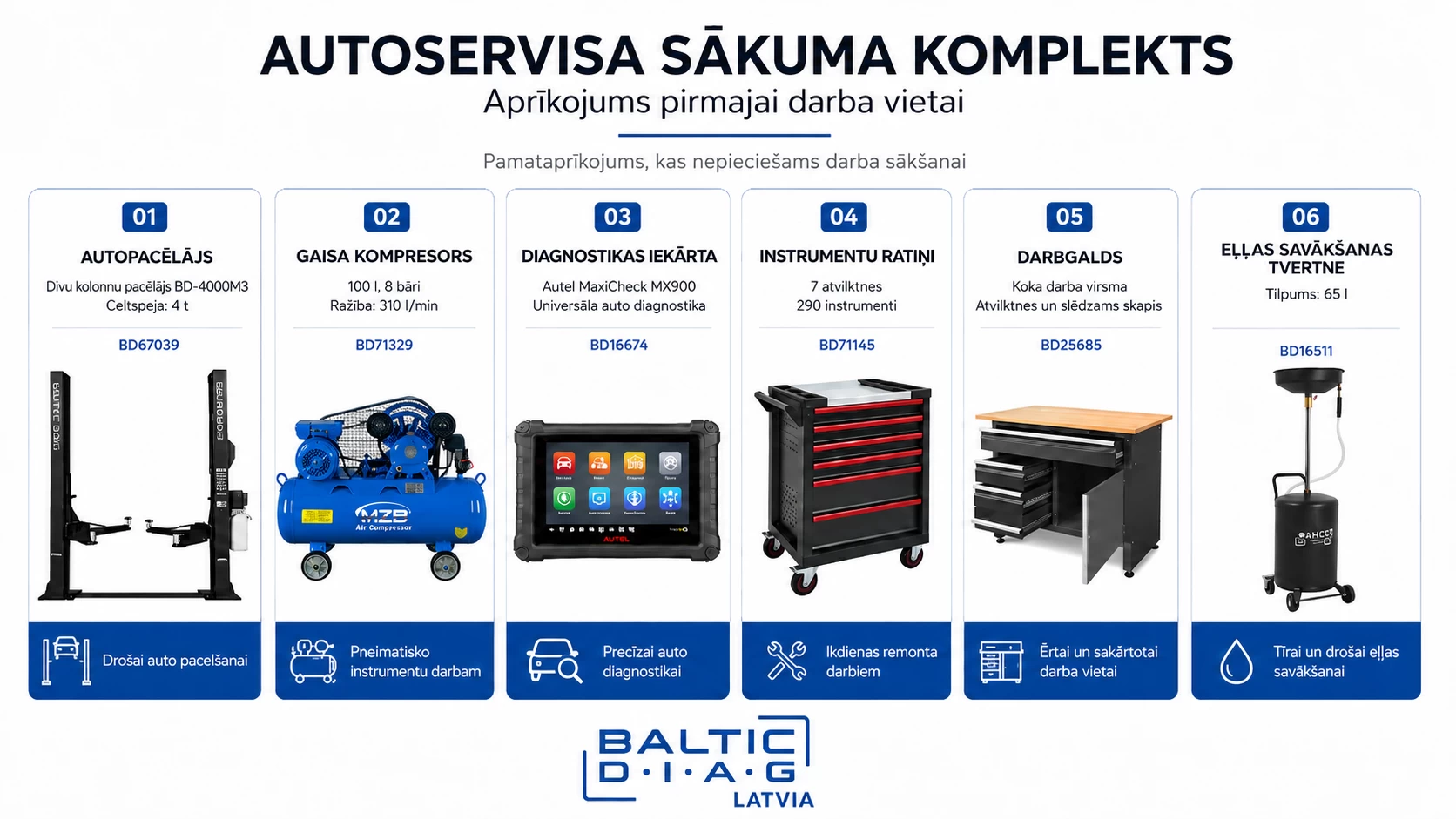
Essential equipment for opening
- a suitable two-post or scissor lift;
- an air compressor with sufficient output;
- professional diagnostic equipment;
- a tool trolley with a core tool set;
- an impact wrench;
- a torque wrench;
- a battery tester;
- a battery charger or support unit;
- a waste oil drain tank;
- a stable workbench;
- work lights;
- personal protective equipment;
- a suitable exhaust gas extraction solution.
Equipment that can be added later
- tire changing and wheel balancing equipment;
- an air-conditioning service station;
- a hydraulic press;
- an automatic transmission service machine;
- a wheel alignment system;
- an ADAS calibration system;
- body repair and welding equipment;
- an additional vehicle lift.
What does this shop not need at the beginning?
If the relevant services are not yet being offered, the shop does not initially need:
- a complete ADAS calibration system;
- a wheel alignment system;
- truck tire equipment;
- an advanced control-unit programming system;
- a body straightening bench;
- high-voltage battery repair equipment for electric vehicles.
Postponing these purchases leaves more working capital available for daily operations and maintenance of the core equipment.
This article was prepared with input from Staņislavs Astahovs, Baltic Diag Latvia's auto repair shop equipment specialist.
Staņislavs' recommendation: at the beginning, most of the budget should be invested in equipment that will be used almost every working day. Specialized machines should be added once the shop has steady demand for the relevant service.
Do not overlook the work environment and safety
Shop efficiency depends on more than lifts and diagnostic tools. Work-area layout, lighting, ventilation, exhaust extraction, floor cleanliness, tool storage, and safe movement routes are also important.
Lighting
An auto repair shop needs:
- even general lighting;
- separate lighting at workbenches;
- portable work lights;
- suitable lighting under vehicles;
- good lighting in the diagnostic area.
Ventilation and exhaust gas extraction
If a vehicle engine is running indoors, sufficient air exchange and suitable exhaust gas extraction must be provided.
Open workshop doors alone may not be enough. Exhaust gases should be removed from the work area in a way that prevents them from re-entering the building. More information is available in the HSE guidance on vehicle exhaust fumes.
Personal protective equipment
Depending on the work, the following may be required:
- protective gloves;
- safety glasses;
- hearing protection;
- safety footwear;
- suitable work clothing;
- respiratory protection;
- a face shield.
Additional occupational safety material is available in the Latvian State Labour Inspectorate's e-learning material for auto and motorcycle service employees.
More than equipment: organizing the auto repair shop
An auto repair shop needs more than physical equipment. From the beginning, plan how you will manage:
- customers and vehicles;
- repair orders;
- work scheduling;
- service history;
- spare parts;
- inventory levels;
- invoices and payments;
- customer updates on job status.
A simple system may be enough at first, but it must be clear and organized. Storing order, parts, and customer information in scattered notes or unrelated spreadsheets quickly leads to mistakes.
Common mistakes when opening an auto repair shop
The service range is not clearly defined
Without a clear service plan, it is difficult to determine which machines are needed immediately and which purchases can be postponed.
Equipment is chosen only by the lowest price
Compare not only the purchase price but also the warranty, maintenance costs, spare-parts availability, licenses, installation, technical support, and possible downtime.
All equipment is purchased at once
This reduces available working capital and increases the risk of buying machines that will rarely be used.
The premises are not properly assessed
A lift, compressor, or other machine may not suit the ceiling height, electrical connection, or available floor space.
Technical service is not checked
Before buying, find out who will handle warranty repairs, how quickly spare parts are available, whether installation and training are offered, and what support is available after the warranty ends.
Equipment is purchased without an overall plan
A good machine may still be unsuitable for the overall workshop system. For example, a tire changer and several pneumatic tools will not operate properly if the compressor output is insufficient.
Frequently asked questions
What is the most important equipment for a new auto repair shop?
A general auto repair shop usually needs a vehicle lift, air compressor, quality tool set, diagnostic equipment, workbench, and technical fluid collection equipment first.
Does all auto repair shop equipment need to be purchased at once?
No. Start with equipment for services that will be offered regularly. Specialized machines can be added as customer demand grows.
Which vehicle lift should a small auto repair shop choose?
The choice depends on ceiling height, floor conditions, available space, the types of vehicles being serviced, and the planned work. Small general workshops often use two-post or scissor lifts.
How should an air compressor be selected?
Calculate the air consumption of the pneumatic tools and machines being used. Also consider simultaneous demand, required working pressure, operating time, and capacity for future growth.
Does a new shop need professional diagnostic equipment?
That depends on the planned services. If the shop will perform electronic system checks, active tests, service functions, adaptations, or coding, professional diagnostic equipment with suitable vehicle coverage will be required.
When is it worth buying tire service equipment?
When there is sufficient customer demand, suitable premises, an adequate compressor, and the ability to organize intensive seasonal work.
Why choose a supplier that offers technical support?
Auto repair shop equipment requires installation, maintenance, and sometimes repair. Accessible technical support and spare parts help reduce downtime.
Choose equipment according to real operating needs
In an efficient auto repair shop, the equipment matches the services, the premises, and the expected workload.
Before purchasing equipment, determine:
- which services you will provide;
- which vehicles you will service;
- how many employees will use the equipment;
- the technical limits of the premises;
- the available budget;
- which services may be added later.
Send us your planned services, workshop dimensions, and available budget. Baltic Diag Latvia specialists will help you build a suitable startup equipment package.
Contact us:
- phone: +371 208 66088;
- email: sales@balticdiag.lv;
- address: 30 Piedrujas Street, Riga.
Browse our auto repair shop equipment or contact a specialist for advice before purchasing.