
Why Do Companies Choose Laser Cleaning Equipment? Pro’s comment
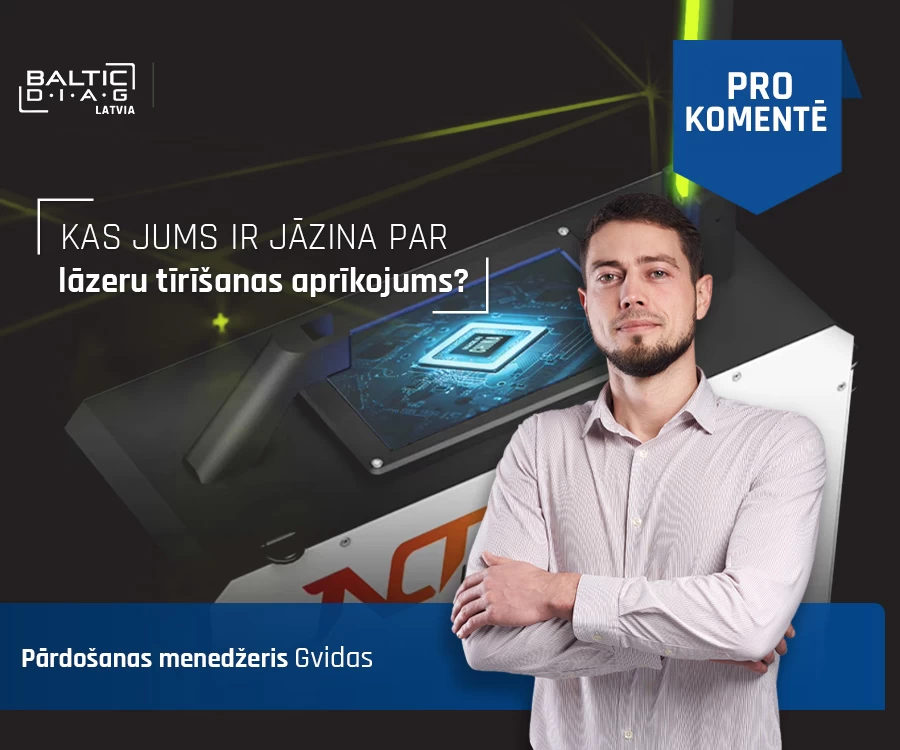
Author: Gvidas Česnauskas, Sales Manager at UAB “Baltic Diagnostic Service”
Gvidas has been working in the industrial equipment field for over 6 years, advising companies on the most suitable technological solutions. His experience covers the needs of both small workshops and large manufacturing companies, so he fully understands the challenges businesses face when implementing new equipment. His practical experience and work with various client projects allow Gvidas to share insights about the benefits and real-world application of laser cleaning technologies.
Laser cleaning is becoming one of the most advanced surface maintenance technologies today. It is used both in industry and cultural heritage restoration because it removes only the unwanted layer—rust, paint, or oxides—without damaging the base.
As an equipment supplier, we at Baltic Diagnostic Service often receive questions about the capabilities, advantages, and safety of this technology. In this article, I will share my expert insights on the benefits of laser cleaning and explain why companies are increasingly choosing this equipment over traditional cleaning methods.
What is laser cleaning technology?
Advantages of laser cleaning:
- No chemical solvents – no need for hazardous substances
- Minimal waste – no abrasives required, removed layer turns into microdust
- Precision – only the unwanted layer is removed
- Surface protection – the process is non-abrasive, so the base is not worn
- Speed – depending on laser power, surfaces are cleaned very quickly
Is cleaning fast?
Small areas can be cleaned in just a few minutes. The speed for large surfaces directly depends on the laser’s power—the higher it is, the faster the job. Therefore, high-power equipment is often chosen in industry to ensure an extremely efficient process.
Is it safe?
The technology is safe if proper safety measures are used: special glasses, workplace ventilation, and surface protection from reflections. The laser itself does not touch the surface, making the process cleaner and safer than many other methods.
What can be removed with a laser?
- Rust and oxides
- Paint and varnish
- Oils, grease, industrial residues
- Soot and other contaminants
Lasers are also excellent for preparing surfaces before painting, gluing, or welding.
Can laser cleaning equipment be used for restoration?
Yes. This equipment is especially suitable for restoration work, as it allows extremely precise removal of only contaminants without damaging the original surface. Lasers are used to restore stone sculptures, monuments, architectural details, and metal artifacts.
Application in industry and other sectors
- Industry: metal processing, rust and oxidation removal, surface cleaning before painting or welding, mold restoration.
- Transport: used in aviation and automotive industries for corrosion removal, paint stripping, and component maintenance. In shipping – for rust and marine residue removal from hulls and equipment.
- Energy: in power plants and the oil/gas industry – for maintenance of pipes, tanks, and structures. In nuclear energy, lasers allow cleaning without additional waste, and pollutants are easily collected.
- Restoration: restoration of stone sculptures, monuments, and historical artifacts without damaging the surface.
- Special applications: cleaning of medical tools, maintenance of food industry molds and equipment without chemicals, removal of oxidation and preparation of electronic surfaces for soldering.
Types of laser devices
- Pulsed lasers – clean surfaces with very short light pulses (nanoseconds). Energy is delivered only to contaminants, which instantly evaporate or turn into microdust. The base remains undamaged. Suitable for removing rust, oxides, paint, varnish, oils, grease, and for restoration of artworks and stone monuments.
- Continuous wave lasers – emit a constant beam that evenly heats contaminants until they separate from the surface. They allow rapid processing of large areas but require precise power regulation to avoid damaging the base. Ideal for removing thick coatings. Often more affordable than pulsed lasers.
- Multifunctional (3in1) lasers – combine three functions in one device: cutting, welding, and cleaning. This solution is especially valued in production lines and repair work, as it allows quick switching between tasks.
Reliability and service life of laser cleaning equipment
Most industrial lasers can operate for tens of thousands of hours without major maintenance. The power source is durable, the optical system lasts for years, and maintenance needs are minimal. Operating costs are low – no need for chemicals or abrasives. The equipment can be used outdoors if the workplace is protected from rain or dust and the operator ensures laser reflection protection.
Laser cleaning technology cost and return on investment
The initial cost of equipment is higher than traditional methods, but in the long run, it often pays off. Operating costs are minimal, as there’s no need for chemicals or abrasives, and the process is faster and more environmentally friendly.
Solutions offered by Baltic Diagnostic Service experts
Baltic Diagnostic Service offers a wide range of laser cleaning equipment: from pulsed lasers to multifunctional systems. Our clients appreciate:
- Competitive prices
- The ability to choose the most suitable power source
- Comprehensive solutions for setting up new workplaces
- Solutions for both small workshops and industrial facilities
Laser cleaning equipment is an investment in a clean, precise, and cost-effective future. This technology enables faster, safer, and more sustainable work while ensuring lower operational costs.
Baltic Diagnostic Service specializes in the supply of laser cleaning equipment. If you are considering which system best suits your needs, our experts are ready to advise and help you choose the optimal solution for your business.