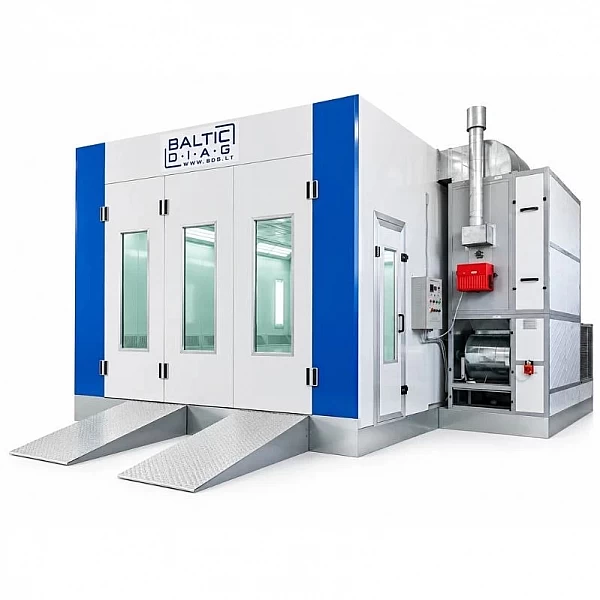
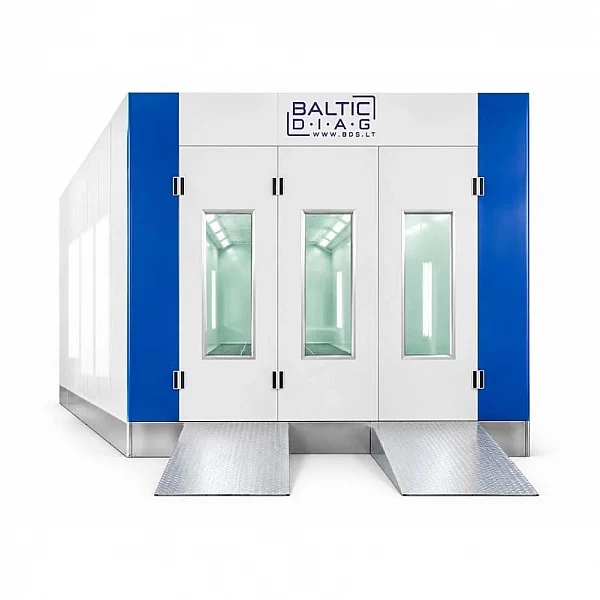
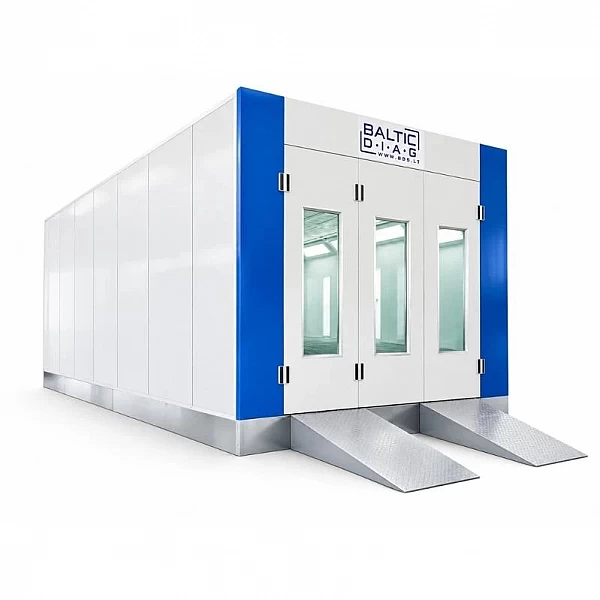
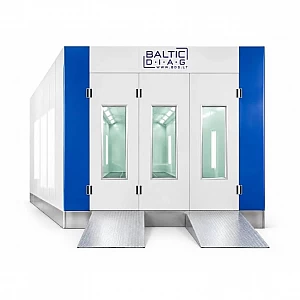
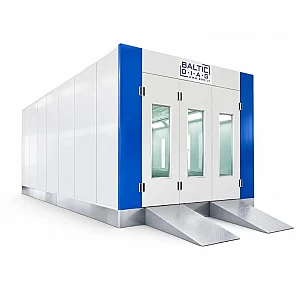
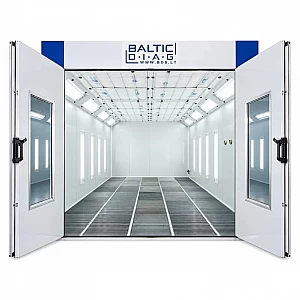
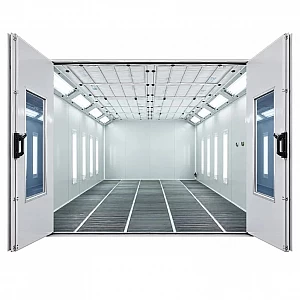
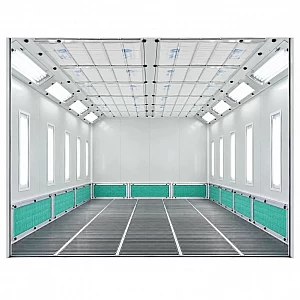
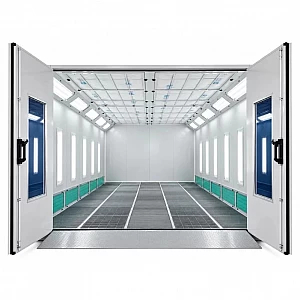
BD-6400 Paint Booth Assembly x 1
Galvanized metal base with filter housings x 1
Set of access ramps x 1
Main door x 1
Staff door x 1
Air intake fans x 2
Air exhaust fan x 1
RIELLO G20 diesel burner x 1
Stainless steel heat exchanger x 1
Filtration system x 1
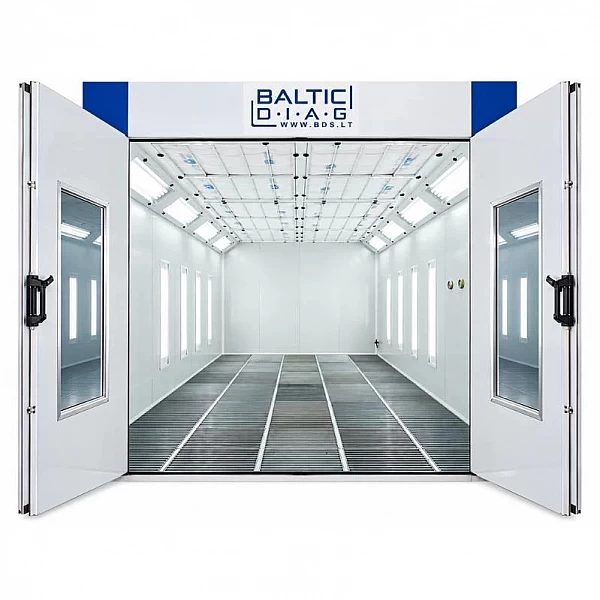
Ceiling-mounted LED lights x 32
Side-mounted LED lights x 32
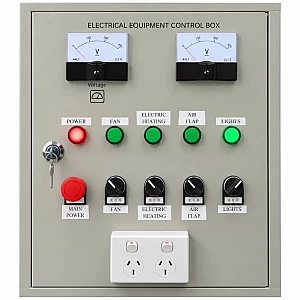
Control unit x 1
Mounting hardware x 1 set
Sealing materials x 1 set
CE certificate x 1
ALSO INCLUDED IN THE SET:
Paint booth pressure safety features:
Additional protection: in the event of an electric motor failure, an automation system malfunction, or operator error resulting in excessive pressure or vacuum, the paint booth is automatically shut down. This helps prevent damage to the paint booth caused by it collapsing, because in the event of an emergency—such as when only the exhaust fan remains running or a damper fails— a very strong vacuum is created, making it extremely difficult to open the exit door—which would endanger the employee inside—and could cause the spray booth structure to collapse. This is the most highly recommended automatic safety feature for a paint booth.
Paint Booth Pressure Control:
To ensure high-quality painting of a part, the air pressure inside the paint booth is critical and should be between 5 and 20 Pa, because:
When painting at a pressure lower than 0 Pa, dust is drawn in from the room.
Painting at a pressure higher than 30 Pa can cause air turbulence, which also compromises paint quality.
1 Pa = 0.00001 Bar; it is practically impossible to determine such a low pressure “by eye,” so we recommend using pressure gauges for measurement and either a mechanical or electronic control method. Whichever method you choose, you’ll also benefit from fuel savings during the winter, as you can reduce the air flow, thereby achieving a higher temperature in the paint booth; in addition, the dampers can be closed at night, preventing the interior of the paint booth from being cooled by the air ducts.
Electronic control:
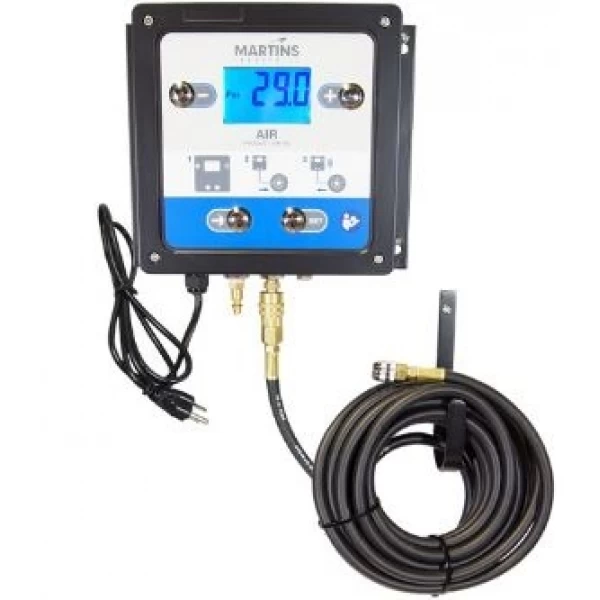
A pressure gauge is mounted on the paint booth’s control panel, displaying the pressure. The pressure is regulated using switches or potentiometers. After work is completed, the dampers close automatically and open again when the paint booth is turned on. Required components include dampers, actuators, a pressure gauge, and control and automation systems.
Pressure gauge with housing and switches/potentiometers, plus connection to actuators and automation (automation components are included in the price).
Electronic dampers—2 units.
Actuator with memory (when the paint booth is turned on, the dampers will return to the same position as set by the potentiometer)—2 units. Actuators are required for electronic damper control.
Overall length: 7,000 mm
External width: 5,350 mm
External height: 3,500 mm
Internal length: 6,900 mm
Interior width: 3,900 mm
Interior height: 2,800 mm
Main door dimensions: 3,000 x 2,705 mm
Service door dimensions: 650 x 2,000 mm
Control unit dimensions: 500 x 200 x 600 mm
Access ramp dimensions: 2,000 x 620 mm
Chimney dimensions: 275 x 250 x 300 mm
Painting and drying of passenger cars in a controlled work environment
Supply of filtered air to the painting area
Removal of particles and contaminated air generated during painting
Floor-mounted air filtration and extraction system
Option to select a fully grated floor
Heating of the work area during the drying of painted surfaces
Effective ceiling and side lighting for the work area
Insulated wall and ceiling panels help reduce heat loss
Galvanized metal base with entry ramps
Separate employee entrance to the booth
Centralized control of painting, heating, lighting, and other chamber functions
Emergency stop function
Option to choose thicker EPS or rock wool insulation upon request
Option to include a gas burner upon request
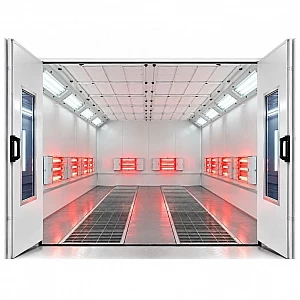
Option to include an infrared drying system upon request
Option to choose an alternative air filtration solution through the chamber walls